
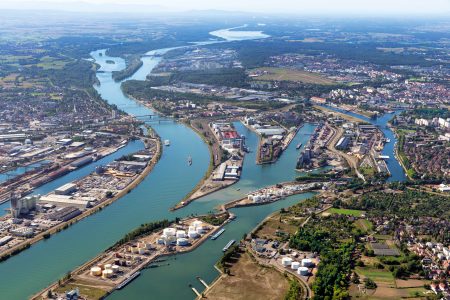
In the second week of August, the Rhine gauge at Kaub, the shallowest chokepoint on the river, fell to a level not seen since records began in 1880, dropping into single digits and forcing many barges to sail at a fraction of their normal load or stop altogether. Forecasters expect no meaningful relief before October. Chemical producers felt it first, with Lanxess saying it was switching to rail and road where possible, and the industrial cluster at Ludwigshafen, which sits just south of the Kaub chokepoint, landing squarely in the disruption zone.
Why the Rhine keeps hitting record lows
What makes this more than a seasonal nuisance is how often it now happens, with 2018 and 2022 both bringing severe low-water disruption before 2026 broke the record again. A shipper can read three events in eight years as bad luck arriving repeatedly, or as evidence that the river has become a variable to plan around rather than a constant to rely on. The second reading changes the question. It stops being how to survive this low-water season and becomes how to run a supply chain that keeps moving when the Rhine does not.
What a rail fallback actually requires
Answering that in practice takes three things, and it pays to be precise about them because a crisis is the wrong moment to discover which one is missing. You need a rail option that genuinely exists, with capacity and terminal slots secured ahead of demand. You need cargo that can change mode without being re-handled. And you need enough visibility over that rail flow to push freight through it under pressure. Miss any one of the three and the fallback stays theoretical exactly when you need it to be real.
How the chemical sector built modal flexibility
BASF is a useful example of a shipper that built all three deliberately rather than assembling them in a hurry. Speaking at Everysens' Rail Tech Masterclass on rail resilience, Axel Franzke, who runs fleet management and workshops at the company's Ludwigshafen site, described a modal split where roughly a third of freight moves by barge, so the river carries real load rather than serving as a side channel. Over about a decade the company built a modular rail system around that exposure: a class of tank container carrying up to 75 tons that separates the tank from the flat car, autonomous vehicles for the heavy first and last mile, and a fully automated depot. Franzke put the combined result at faster, more flexible and around 25 percent cheaper, with more than 1,400 of the containers now in service.
The feature that matters when the river closes is the modularity. Because the product travels in a container approved for both road and rail rather than in a fixed rail tank car, a flow can be shifted onto rail and handled on the first and last mile by road using the same sealed unit, with no repackaging at the switch. That craneability is what makes a fast diversion practical, and it is close to impossible to improvise once a low-water crisis is already underway. Franzke was also candid that the approach has limits, pointing to Germany's ageing rail infrastructure and the disruption expected from Europe's digital coupling transition, a reminder that rail hedges the river without erasing its own fragilities.
What shippers on the Rhine should do now
Three moves are worth making before the next drought rather than during it:
- Treat low water as a scheduled risk. Secure rail capacity and terminal slots ahead of the summer season, while they are still available, rather than bidding for them once every major producer on the river wants the same slot.
- Design flows so cargo can change mode without changing packaging. Modular, craneable units are what make a road-to-rail switch executable at speed.
- Instrument the fallback before you lean on it. A rail alternative you cannot see, where you do not know where wagons sit or how full they run, is not usable capacity under stress.
None of this makes rail a cure-all, and it does not replace the river, since even well-built rail systems strain against the infrastructure and coupling constraints Franzke flagged. What a modular, instrumented rail option buys is somewhere to send freight when the water drops, while a shipper without one simply absorbs the hit to production and cost.
The visibility question is where this turns from strategy into execution, and it is the problem Everysens works on. Knowing where your wagons are, how full they run and when they will arrive is what turns a rail fallback from a line on a contingency slide into capacity you can actually move freight through when the Rhine will not cooperate. Franzke's full account of how BASF engineered that flexibility, including the automated depot and the last-mile vehicles, is covered in our latest RTMC with Axel Frankze of BASF.


